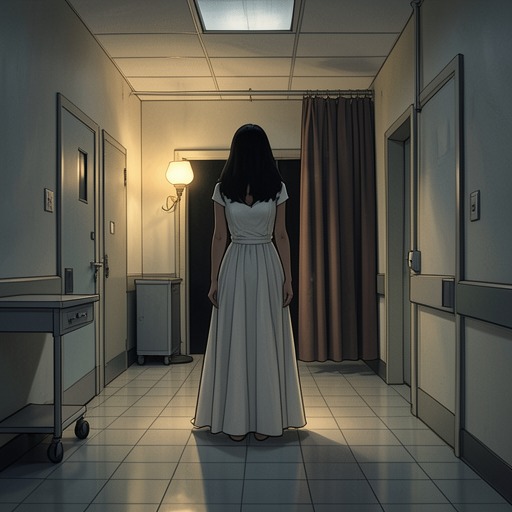
Bénédicte's suicide attempt by overdose and admission to Sainte-Blandine
L'Amour et les ForêtsBénédicte’s overdose and admission to Sainte-Blandine mark both an escape from an intolerable home life and a temporary opening in which she can begin to imagine another one. The clinic offers protection, companionship, and time to consider a radical decision; its brevity, however, leaves her back in the circumstances from which she had tried to escape.
Circumstances and Crisis
The admission follows Bénédicte’s attempt to end her life by taking twelve pink pills. The crisis has developed within a marriage in which her movements are closely monitored and her husband, Jean-François, expects to know where she is and when she can be reached. Bénédicte has explained that she has no mobile phone because her husband fears she might use one to build a social life of her own. With a landline, her timetable is known to him, and she is expected to return home after her classes. She describes herself as not literally captive, but recognizes that he keeps track of her whereabouts. Her decision to disappear from his view for several hours has already shown how limited her freedom is and that even a brief exercise of independence may carry consequences.
After her affair with Christian, the surveillance becomes an unrelenting campaign of questioning. Jean-François calls repeatedly during the day, wakes her at night, and questions her when she is trying to sleep or shower. His interrogations return to the same details, seeking inconsistencies and demanding that she recount what happened. The recurrence matters: the pressure is not a single dispute that ends when she answers, but a routine that reaches into her sleep and leaves her with little respite. Against this background, the overdose is bound up with a broader crisis of confinement and exhaustion, rather than presented as an isolated episode without context.
The Clinic as a Reprieve
At Sainte-Blandine, Bénédicte encounters people with whom she quickly forms close bonds. Within two weeks, she feels more attached to the other residents than to people she knows outside the clinic. She sees them as having confronted forms of self-deception and become more candid with themselves; their company helps her see her own life differently. In the nine-square-metre room that Élisa affectionately calls her poet’s cell, Bénédicte feels she has at last found a place where she belongs.
The contrast with home also changes how she experiences Jean-François. The residents’ evident aversion to him, and their solidarity with her, make the burden of his presence feel less absolute. She begins to recognize that the force he has over her is not simply a measure of his importance: when she concentrates on refusing him that power, she can see him as diminished and his hold as less inevitable. This shift does not end his conduct. He visits her at the clinic and continues to question her, while staff members appear to understand that a patient who will not explain a suicide attempt and insists on remaining in hospital may be facing mistreatment at home. Their awareness makes the ward a place where his behavior is not accepted as an ordinary private matter.
Time to Imagine a Different Life
The clinic gives Bénédicte more than immediate shelter. She wants to stay long enough to make a decisive choice about the future, rather than return before she has recovered the strength to act. She imagines leaving Jean-François, moving away from Metz with her children, and beginning again in unfamiliar surroundings. The possibility of working in publishing in Paris also takes shape as a potential future. These are not settled plans; she sees that a new life would require time to turn a fragile wish into a practical decision.
Writing belongs to this period of self-examination, though Bénédicte does not think of herself as a public writer. She writes privately at night, for her own sense of discovery and accomplishment. The prospect of exposing herself through published writing feels too vulnerable, as though writing made her visible to unseen observers. By contrast, editorial work seems conceivable if she can build the confidence and resolve to make it real. The distinction shows how the stay allows her to explore possible forms of independence without pretending that imagining them has already made them attainable.
Discharge and the Collapse of Hope
The psychiatrist grants Bénédicte four additional days but ultimately tells her she must go home. She understands the decision as a premature ending to the time she needed: building a future, in her view, takes longer than the two weeks she has spent in the clinic. The brief admission has allowed her to sleep somewhat better, and Jean-François has stopped waking her to question her about Christian. Yet his indifference after she returns does not feel like safety. It leaves her with the same profound loneliness and heaviness she had experienced before the overdose.
During her stay, she had imagined happiness as a future she was approaching, even picturing a life with Christian. Discharge abruptly breaks that expectation. She experiences the return home as being trapped again beneath a hope that had seemed to lift her, with Jean-François and the life he imposes standing between her and the freedom she had begun to imagine. For months she feels as though she is back in a dark confinement, weeping again. Her account thus distinguishes the real value of hospitalization from any claim that it cured the conditions surrounding her: the clinic gave her a glimpse of change, but could not secure the time or circumstances needed to carry it through.
Later Significance
The reprieve does not remain her only source of renewed hope. In September 2007, reading The Éric novel Bénédicte read gives her another moment of light: she raises her head, begins to believe in herself again, and wants to re-enter ordinary life and seek happiness. This later return of hope underscores both the limits and the importance of the hospitalization. Sainte-Blandine offered a first protected interval in which Bénédicte could imagine leaving, while the forced return showed how quickly that possibility could be overwhelmed when she was again alone with the conditions she had sought to escape.